
Explore the Cat's Eye Nebula through a new ESA and NASA collaboration, revealing its intricate structure in stunning detail. Learn about its historical sig
Discovery and Observation
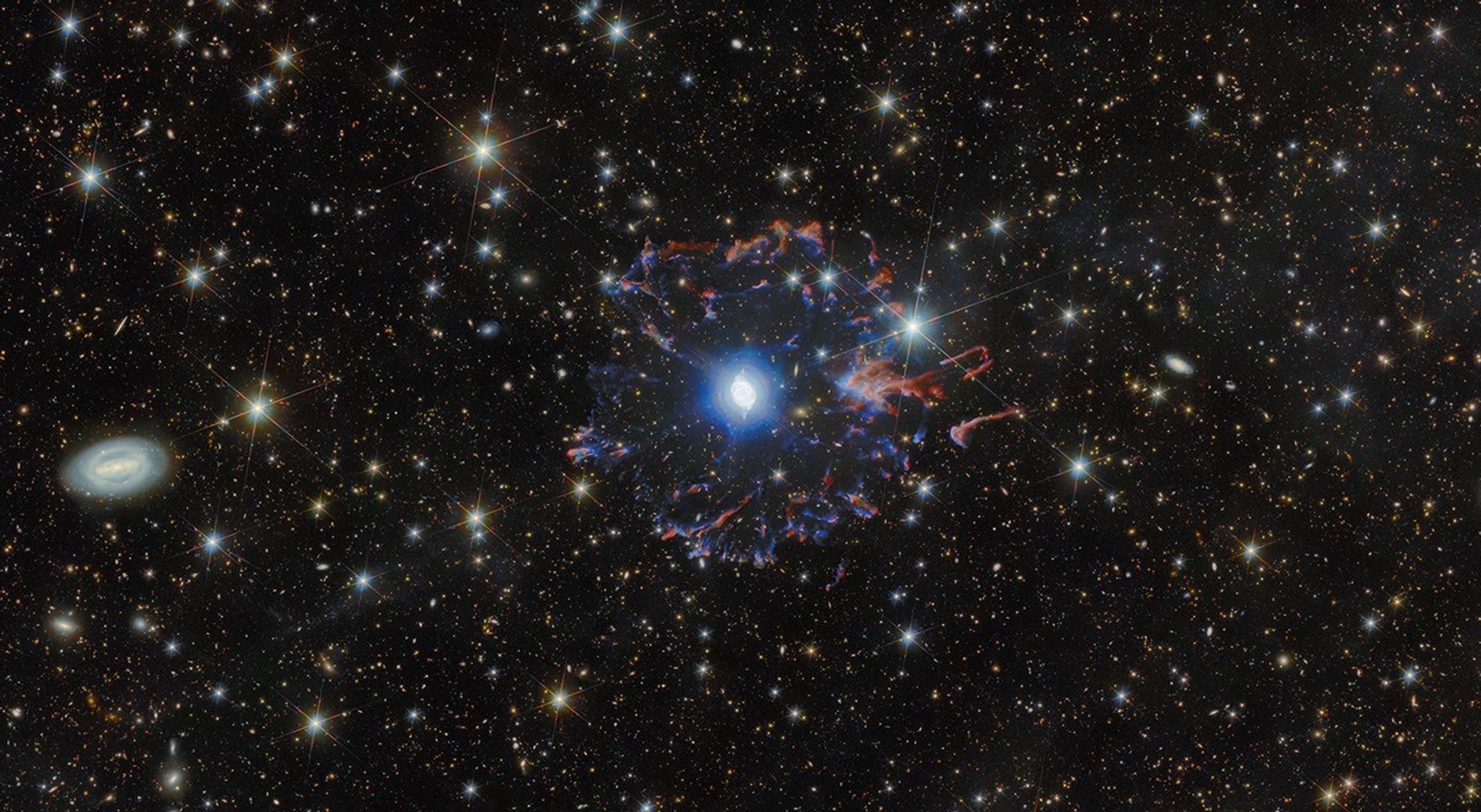
On March 3, 2026, an image was released combining views from the European Space Agency’s (ESA) Euclid satellite and NASA’s Hubble Space Telescope. This collaborative effort produced a stunning visual of the Cat’s Eye Nebula, also known as NGC 6543. Located approximately 4,400 light-years away in the constellation Draco, this planetary nebula has fascinated astronomers for decades due to its intricate and layered structure.
Historical Significance
The Cat’s Eye Nebula, first observed in 1786 by William Herschel, is a prime example of a planetary nebula, a transient astronomical phenomenon that occurs when a dying star ejects its outer layers into space. These nebulae, often symmetrical and colorful, provide crucial insights into the late stages of stellar evolution. The Cat’s Eye Nebula’s complexity, visible in the new composite image, has made it a focal point for astronomers studying these fascinating structures.
Technological Advancements
The image combines data from the Euclid satellite, which specializes in probing the dark energy and dark matter that make up most of the universe, with observations from the Hubble Space Telescope. Euclid’s advanced imaging capabilities, combined with Hubble’s long-standing expertise in capturing detailed images of deep space, offer a unique perspective on the nebula’s structure. The resulting image showcases the intricate details of the Cat’s Eye Nebula, highlighting its complex layers and vibrant colors.
Scientific Insights
This observation reveals new information about the dynamics and composition of the Cat’s Eye Nebula. The composite image, created by the Euclid Consortium, ESA, and NASA, offers a detailed view of the nebula’s intricate layers and the interaction of gases and dust. Astronomers are particularly interested in understanding the processes that lead to the formation of such elaborate structures and the physical conditions within the nebula.
Conclusion
The Cat’s Eye Nebula, a visually stunning and scientifically significant object, continues to captivate astronomers with its complex structure and vibrant colors. The new composite image, a collaboration between ESA’s Euclid and NASA’s Hubble, provides valuable insights into the late stages of stellar evolution and the processes that shape planetary nebulae. As researchers continue to study these phenomena, they gain a deeper understanding of the universe’s past and future.
Source: Read Original Article
Post a Comment