
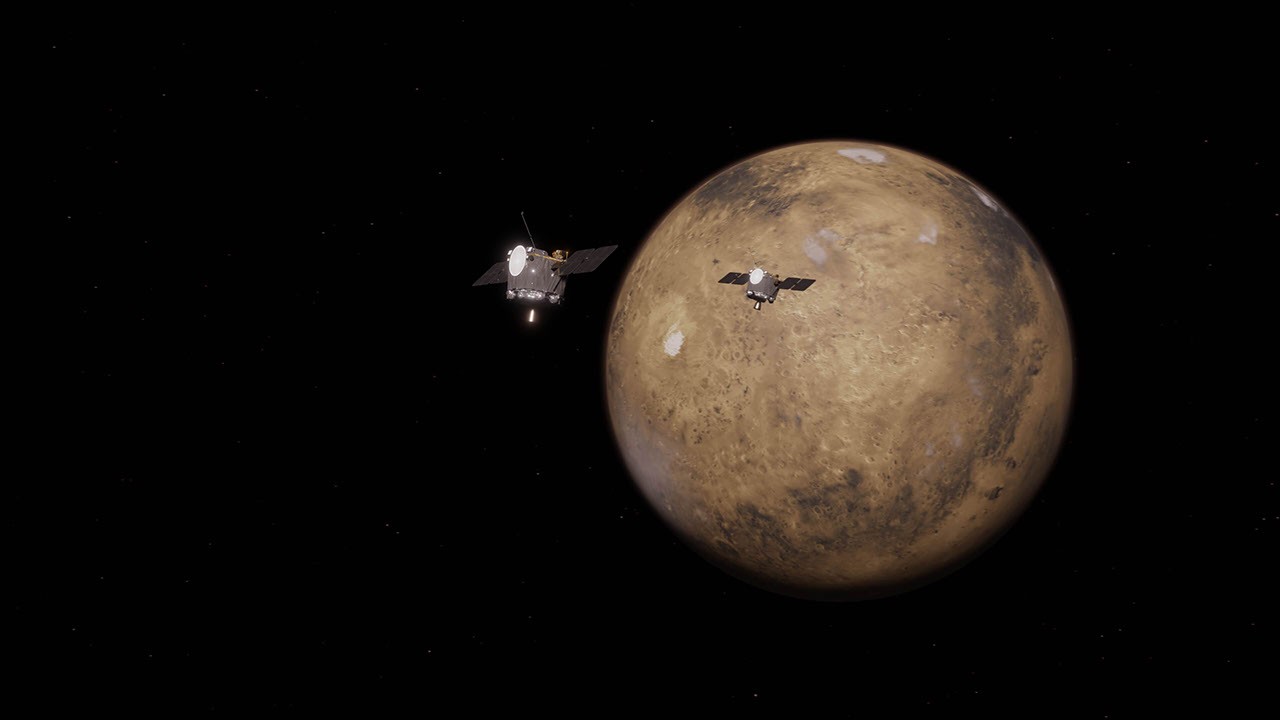
Explore Earth's distant magnetotail and study atmospheric particles with the ESCAPADE mission's unique loiter orbit before heading to Mars.
Mission Overview
On February 24, 2026, the Earth Surface Constellation for Atmospheric Particle Analysis and Dynamics (ESCAPADE) mission is set to embark on an unprecedented journey. This mission will utilize a unique "loiter" orbit around Earth to conduct scientific research before continuing its trajectory towards Mars.
The Loiter Orbit
In November 2026, when Earth and Mars align in their orbits, the spacecraft will return to Earth's vicinity to take advantage of our planet’s gravity for a slingshot maneuver. This maneuver will propel the spacecraft towards Mars while extending it approximately 2 million miles from Earth. Never before has an Earth-orbiting spacecraft ventured so far into the distant magnetotail—a region opposite the Sun within Earth’s vast magnetosphere.
Scientific Objectives
"During this 'loiter' phase, we'll conduct some groundbreaking discovery science," stated principal investigator Dr. Lillis. "No one has ever measured Earth's tail this far away." This mission will provide critical data on how Earth's magnetotail behaves under various solar wind conditions, enhancing our understanding of the complex interplay between our planet and the sun.
Mission Trajectory and Objectives
The two ESCAPADE spacecraft, designated in cyan in visualizations from NASA’s Scientific Visualization Studio, will venture about 1.2 million miles from Earth before heading towards Mars. During their 10-month cruise to the Red Planet, these satellites will study solar wind dynamics and the interplanetary magnetic environment. This research is crucial for preparing future astronauts traveling to Mars by offering insights into the space weather conditions they will encounter.
Mission Support and Partners
Funded by NASA’s Heliophysics Division, ESCAPADE is part of the Small Innovative Missions for Planetary Exploration program. UC Berkeley’s Space Sciences Laboratory leads this mission with key support from Rocket Lab, NASA's Goddard Space Flight Center in Greenbelt, Maryland, Embry-Riddle Aeronautical University, Advanced Space, and Blue Origin.
This mission not only aims to extend our knowledge of Earth's magnetosphere but also sets the stage for future exploration of Mars. Through these ambitious goals, ESCAPADE promises to deliver valuable data that will advance space science and pave the way for interplanetary travel.
Source: Read Original Article
Post a Comment