
A computational model using LS-DYNA and Python script to simulate reentry parachute EM failure mechanisms, enhancing predictability under dynamic loading.
Introduction
A computational model has been developed to investigate the failure mechanisms of reentry parachute energy modulators (EMs) at the fabric weave level, using the simulation software LS-DYNA. This model aims to address the increasing variability in EM behavior observed during recent flight tests, which raises concerns about their performance predictability and potential failure under dynamic loading conditions.
Objective and Approach
The study was structured into two primary objectives. The first was to develop a per-unit stitch model that accurately captures the geometry and material behavior of the EM stitching pattern. The second objective involved creating a Python script to automatically duplicate the unit model along the full length of an EM ear, simplifying the process of generating complex, patterned geometries in LS-DYNA.
### Fabric Modeling
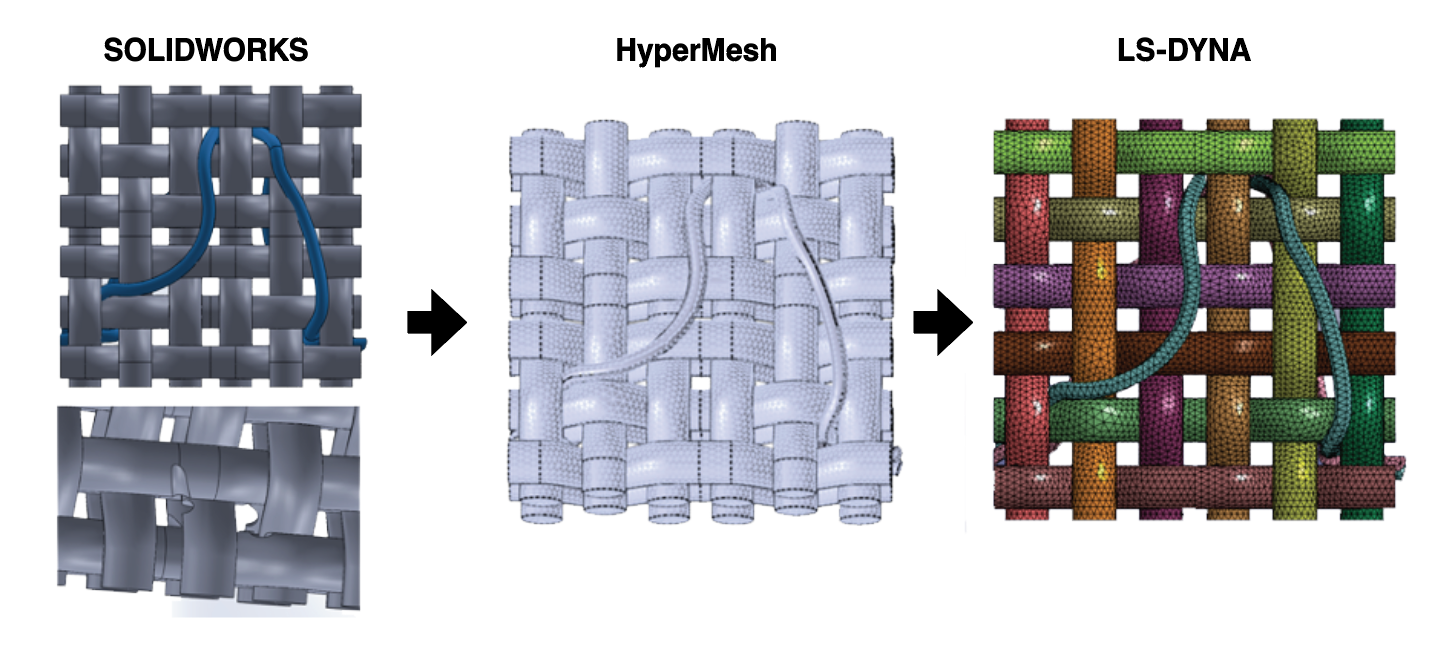
The per-unit model began with the creation of a 3D Kevlar weave geometry using TexGen, an open-source software developed at the University of Nottingham. CAD software was then used to add a nylon zigzag stitching pattern, consisting of a bobbin thread and a needle thread that looped through the top and bottom layers of the Kevlar fabric and twisted together at the end of every stitch between the two layers. This intricate model was meshed in Hypermesh with 3D tetrahedral solid elements, enabling detailed analysis of the failure mechanisms of the nylon stitching and Kevlar weave during EM shredding events.
### Simulation Setup and Validation
In LS-DYNA, material properties, contact conditions, failure criteria, and boundary conditions were defined to simulate the dynamic response of a stitch during tensile loading. The material behavior for both fabric types was defined using *MAT_ELASTIC (*MAT_001), and two-way, surface-to-surface contact with erosion was implemented to accurately capture the progressive failure of the Kevlar weave and nylon threads. To streamline the model, the study employed several techniques, including manual mass scaling, characteristic length analysis, and mesh quality optimization. Preliminary results confirmed the effectiveness of using solid elements to simulate EM behavior, particularly the interaction between Kevlar and nylon threads.
Automation and Efficiency
To facilitate the construction of full-length EM models, a Python script was developed to replicate the per-unit LS-DYNA model along the length of an EM ear. This automation eliminated the need for large CAD assemblies, generating the full model directly from the unit model. The model is applicable to both solid and shell 2D and 3D elements, providing a versatile tool for evaluating new EM design variations.
Conclusion
The computational model developed in this study will not only aid in identifying the root cause of EM shredding but also support the evaluation of new EM design variations. This modeling approach has broader implications for other work involving fabrics, enabling more accurate simulations and efficient design workflows in aerospace textile applications.
Source: Read Original Article
Post a Comment