
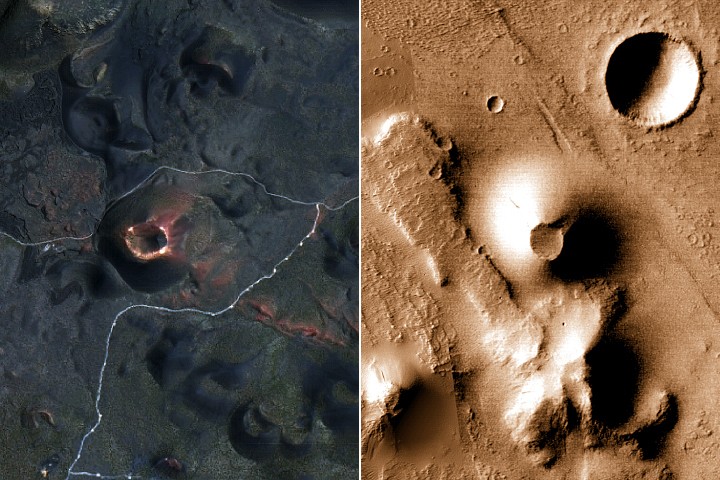
Discover how Dr. Jan Brož's research distinguishes volcanic from non-volcanic Martian features, crucial for accurate geological interpretation.
Study of Martian Landscapes
The exploration of Mars has been enriched with new insights into the planet's diverse and complex geology. Recent research conducted by Dr. Jan Brož from the University of Colorado Boulder highlights the importance of distinguishing between various geological formations, particularly when volcanic activity is suspected.
Distinguishing Between Volcanic and Non-Volcanic Features
Dr. Brož’s work emphasizes the critical role of careful observation in identifying true volcanic features on Mars. While certain regions exhibit clear evidence of explosive volcanism based on their surrounding landscapes, ambiguity can arise in less obvious terrains. His laboratory studies suggest that mud flows, which are common on Mars, may mimic lava flows under specific conditions.
Comparative Earth vs. Mars Geology
Dr. Brož cautions against relying solely on terrestrial analogues when interpreting Martian geology. "We must avoid being constrained by our understanding of Earth," he states, adding that failing to think outside traditional paradigms can lead to overlooking significant geological features. For instance, under certain conditions, mud flows on Mars might appear similar to lava flows and even exhibit behaviors such as boiling and levitation.
Implications for Future Exploration
The findings underscore the need for advanced analytical tools and innovative methodologies in future missions. NASA’s Earth Observatory images, derived from Landsat data and the Context Camera (CTX) on the Mars Reconnaissance Orbiter, provide valuable visual insights into these complex geological processes. These resources are essential for distinguishing between different types of flow features on Mars.
Conclusion
As Mars exploration continues to evolve, researchers like Dr. Brož emphasize the importance of maintaining an open mindset and avoiding overly terrestrial assumptions. By doing so, they can better understand the unique geology of our neighboring planet.
Source: Read Original Article
Post a Comment