
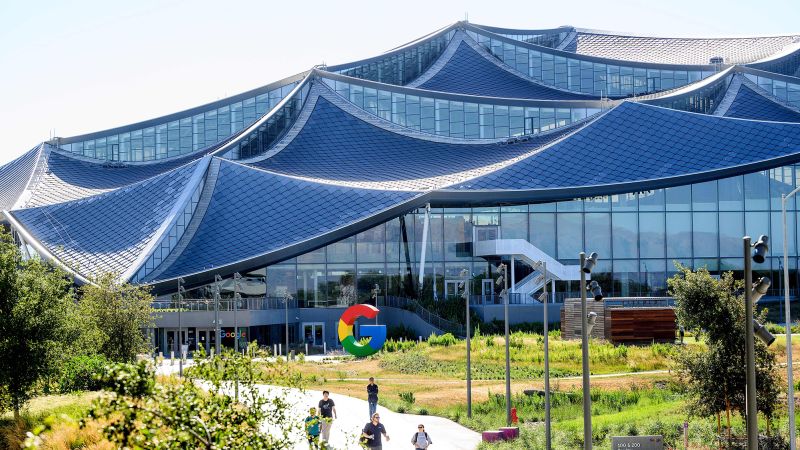
International News: Alphabet's Shares Dip Over Concerns of Market Share Loss in Search Engine Sector to AI-Powered Rivals
In a significant development, shares of Alphabet Inc., Google's parent company, declined by more than 3% in early trading on Monday, following reports suggesting potential market share erosion in the search engine sector due to AI-powered competitors, including Microsoft's Bing.
According to a report published by The New York Times, concerns within Google were raised last month after Samsung allegedly considered making Bing the default search engine on its devices instead of Google's search engine. This shift reportedly caused internal turmoil at Google, as per the article, which cites internal messages and documents but has not reviewed the material itself.
In response to heightened competition, Google is reportedly working on a new AI-powered search engine dubbed Project "Magi." The project, which currently employs approximately 160 people, aims to revolutionize the appearance of results in Google Search and will incorporate an AI chat tool designed to answer queries. The project's public unveiling is expected next month, according to the report.
In a statement sent to CNN, Lara Levin, a Google spokesperson, acknowledged the company's long-standing use of AI to enhance search results and introduce new methods, such as last year's feature that allows users to search by combining images and words. She emphasized Google's commitment to maintaining quality information while introducing AI-powered features in Search, with further details to be shared soon.
Samsung did not immediately respond to a request for comment. It is important to note that Google's search engine has held a dominant position in the market for two decades. However, the viral success of ChatGPT, an AI model capable of generating written responses to user prompts, seems to have raised fresh concerns about Google's market position.
In an unprecedented move, tech giant Google has introduced Bard, its new AI chatbot, marking a direct competition with ChatGPT. Launched in March, Bard is designed to assist users in drafting essays, planning events, and offering meal suggestions based on fridge contents. At a February event, a Google executive announced plans to integrate generative AI into Google's core search product and leverage artificial intelligence to shape the "next frontier" of their information offerings.
Microsoft, collaborating with OpenAI - the creators of ChatGPT - is deploying similar technology in Bing and other productivity tools. Various tech companies, including Meta, Baidu, IBM, and numerous startups, are actively developing AI-driven tools. However, this technological advancement brings risks, as AI systems are known for errors and "hallucinations" in responses. This is particularly concerning for search engines, a primary source of accurate and reliable information for many users.
Google encountered criticism following a Bard demo that provided an incorrect response to a telescope query, causing a 7.7% drop in shares for Google's parent company Alphabet, resulting in a $100 billion market value loss. Microsoft's Bing AI demo also faced scrutiny due to several errors, such as misidentifying vacuum types and providing false information about certain products.
In a recent 60 Minutes interview, Sundar Pichai, CEO of Google and Alphabet, emphasized the importance of corporate responsibility during the development and release of AI tools. For Google, he stressed the need for user feedback and developing more robust systems to ensure accuracy.
In an address, tech magnate Elon Musk emphasized the importance of implementing safety measures before the development and deployment of more advanced AI models. He further articulated his conviction that these artificial intelligence tools will bring far-reaching effects on various industries, professions, and society at large. "This technology," Musk stated, "will influence every product within every company, making it a profoundly transformative force." He added, "We are still in the early stages of this revolution."
Source: Read Original Article
Post a Comment