
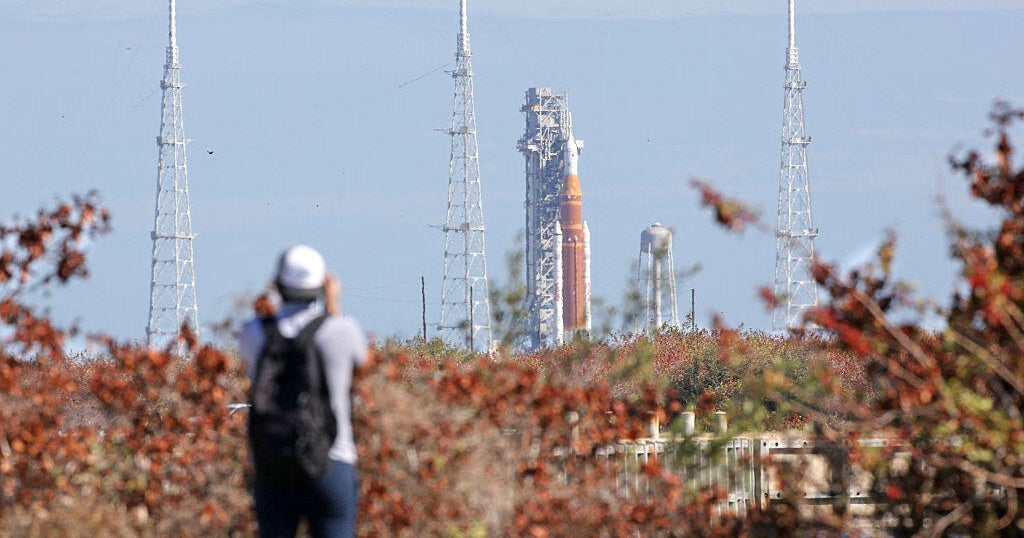
Overnight on Friday, engineers encountered issues during the repressurization of the upper stage helium tanks of NASA's Artemis II moon rocket, leading to preparations for rolling the colossal rocket off its launch pad and back to the Vehicle Assembly Building (VAB) for further investigation. This setback will move the already postponed mission from March into early April, as confirmed by NASA officials on Saturday.
Pressurized helium is crucial for propelling propellants to rocket engines during ignition and for purging fuel lines before propellants flow. The root cause of the helium supply disruption remains undetermined, following a successful countdown rehearsal test that concluded on Thursday.
NASA Administrator Jared Isaacman explained via social media platform X that the problem can only be addressed within the VAB. Rollback preparations have commenced, ruling out the possibility of a March launch.
The Artemis II mission intends to orbit the far side of the moon with a crew of four astronauts: Reid Wiseman, Victor Glover, Christina Koch, and Canadian astronaut Jeremy Hansen. The primary objective is to rigorously test NASA's Orion deep space capsule in preparation for the Artemis III lunar landing mission, scheduled for 2028.
Currently, teams are examining potential reasons behind the issue, including possibilities at the interface between ground and rocket helium lines, a valve within the upper stage, and a filter connecting the ground and rocket components. Further updates will be provided as more information becomes available.
Artemis II Moon Mission Delays Persist as Launch Date Shifts to March 6
The Artemis II mission's launch date has been rescheduled for March 6 due to hydrogen leaks detected during an initial rehearsal. This decision comes amidst a limited number of available launch opportunities each month that align with the mission's requirements, with the current period concluding on March 11.
The next potential launch windows are scheduled for April 1, 3, 4, 5, and 6, as the positions of Earth and moon impact lighting and other factors essential for a successful mission. Originally, astronauts Wiseman, Glover, Koch, and Hansen aimed for an early March launch, but the hydrogen leaks necessitated a reevaluation.
On Thursday, NASA conducted a second fueling test and countdown, successfully loading the Space Launch System rocket with over 750,000 gallons of liquid oxygen and hydrogen fuel without encountering any fuel leaks similar to those that caused the initial delay. Mission managers announced plans to proceed with a launch attempt on March 6, pending final confirmation.
In preparation for the revised launch date, astronauts have entered pre-flight medical quarantine at the Johnson Space Center and are scheduled to travel to the Kennedy Space Center on March 1. They will now emerge from quarantine to monitor further developments.
Jared Isaacman, a private astronaut participating in the mission, expressed understanding for public frustration over the delay. He emphasized that the disappointment is most keenly felt by NASA's dedicated team, who have been tirelessly preparing for this significant endeavor.
Since its inception during NASA's Apollo program from 1968 to 1972, only 24 astronauts have journeyed to the moon. The Artemis program has thus far completed a single flight, a lunar-orbiting mission without a crew, marking a significant step towards renewed lunar exploration.
2022: President Issacman Announces Artemis Program, Aiming to Exceed Apollo Achievements with Lunar Base and Continuous Missions
President Jared Isaacman of the United States has reiterated his commitment to the Artemis program, stating it will surpass the nation's accomplishments during the Apollo era. He confirmed plans for a future lunar base and ongoing missions within the lunar environment.
Isaacman emphasized that the initial stages of this program will not represent its ultimate capabilities: "Where we begin with this architecture and flight rate is not where it will end."
Source: Read Original Article